
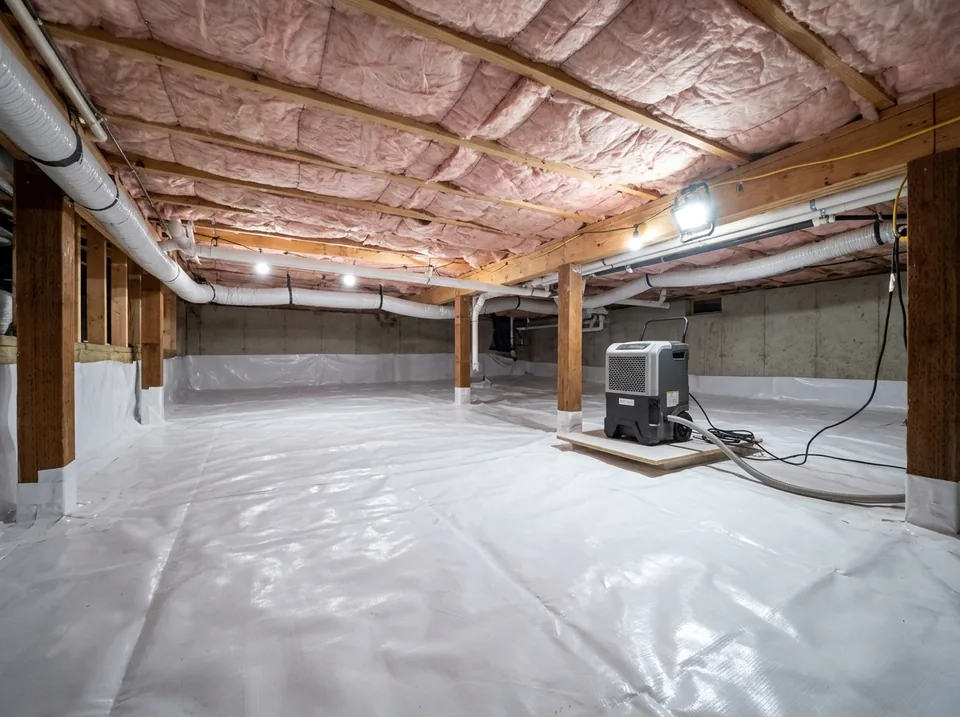
Basement flooding threatens finished living space, drywall, flooring, and electrical panels immediately, whereas crawl space water hides out of sight beneath wooden joists—silently saturating fiberglass insulation, driving up indoor humidity via the stack effect, and cupping main-floor hardwood. Both require prompt pumping and commercial dehumidification in Burien's wet climate.
Drive through Burien from the wooded bluffs of Seahurst and Shorewood east toward Boulevard Park and you will see two dominant foundation styles across the city's mid-century housing stock: sloped-lot daylight basements and vented dirt crawl spaces. Because Sea-Tac and King County rain gauges record roughly 38 to 41 inches of annual precipitation—with about 75% falling between October and March—both foundation types face intense seasonal moisture stress. Yet homeowners often treat them very differently, assuming a wet crawl space is "normal for the Northwest" while panicking only when water reaches a finished basement carpet. Understanding how water behaves in each space helps you act before structural framing or indoor air quality suffers.
Why Burien's Geography Creates Two Distinct Lower-Level Water Problems
Burien sits on glacial soils sculpted into steep western coastal bluffs and three main stormwater watersheds: Miller Creek, Walker Creek, and Salmon Creek. On sloped western lots in Seahurst, Three Tree Point, and Gregory Heights, houses are cut into the hillside so the uphill side is buried below grade while the downhill side opens to a yard or view. That daylight-basement layout is comfortable for living space, but it puts buried concrete walls directly in the path of downhill groundwater movement.
Meanwhile, flatter lots around Lake Burien, Olde Burien, and Boulevard Park frequently sit over 2-to-4-foot vented crawl spaces with exposed soil covered by thin black or white polyethylene sheeting. When heavy rain raises the local water table or a kitchen drain pipe drips unnoticed beneath the subfloor, water pools in low pockets under the house where nobody sees it for weeks.
Side-by-Side Comparison: Crawl Space Water vs. Basement Flooding
| Factor | Crawl Space Water Intrusion | Daylight / Full Basement Flooding |
|---|---|---|
| How homeowners notice it | Often delayed—musty odors from floor vents, cupping oak floors, or high window condensation. | Immediate—visible standing water on concrete or squelching carpet in lower rooms. |
| Primary structural risk | Saturated fiberglass batts trapping moisture against Douglas fir joists, rim joists, and subfloors. | Drywall wicking, rotted wood sill plates, ruined flooring, and electrical/HVAC damage. |
| Typical water category | Category 2 or 3 (groundwater/soil contact or broken drain line); Category 1 if clean supply pipe only. | Category 1 (water heater/pipe burst) or Category 3 (exterior stormwater or floor-drain backup). |
| Extraction equipment used | Low-profile submersible pumps, long-reach vacuum hoses, mud/debris clearing in confined space. | High-volume submersible pumps, truck-mounted extractors, weighted carpet wands. |
| Material teardown needed | Wet belly insulation and torn/flooded vapor barrier sheeting removed and bagged. | Soaked carpet pad, swollen laminate, baseboards, and 12–24 inch drywall flood-cuts. |
| Drying approach | Ducted LGR dehumidifiers + compact axial air movers targeting wood joists below 15% MC. | Closed-room LGR dehumidifiers + radial air movers drying concrete slabs and stud bays. |
The Hidden Mechanics of Crawl Space Moisture: Stack Effect & Wood Decay
Many Pacific Northwest homeowners assume that because a crawl space is separated from the living room by plywood and insulation, standing water underneath does not affect upstairs air. Building science proves the opposite. Through a natural airflow process called the stack effect, warm air rises and escapes through upper ceilings and attic vents, creating gentle negative pressure that pulls replacement air upward from the crawl space through plumbing chases, recessed ductwork, and floor seams.
When standing water sits under a Burien rambler, relative humidity inside the crawl space quickly climbs past 85% to 95%. Fiberglass insulation batts hung between floor joists absorb that airborne humidity, become heavy, sag away from the subfloor, and hold liquid moisture tightly against wooden framing. Once wood moisture content stays above 20% for extended periods, fungal decay and surface mold colonize the underside of your subfloor—and upstairs hardwood planks absorb moisture from below, causing edges to cup upward. That is why timely crawl space water removal involves far more than dropping a garden pump through the hatch: soaked insulation and flooded poly sheeting must be cleared so framing can actually dry.
Basement Flooding in Burien: Hydrostatic Pressure & Finished-Wall Wicking
In a daylight or full basement, concrete slabs and poured foundation walls create a rigid tub. When winter runoff overwhelms exterior footing drains, hydrostatic pressure pushes water through the cove joint (where the vertical wall meets the horizontal floor slab), hairline shrinkage cracks, or basement window wells. If the basement is unfinished concrete, cleanup is relatively fast—pumping, sanitizing, and drying the slab.
However, many Burien basements have been finished into bedrooms, home offices, or rental ADUs with framed stud walls, fiberglass batt insulation, carpet, and drywall. Within two hours of flooding, gypsum drywall wicks water upward past the baseboards, while carpet padding locks gallons of contaminated groundwater against the slab. Proper basement flood cleanup requires stripping unsalvageable pad, making clean flood-cuts above the moisture line so wet framing cavities can breathe, and treating concrete and sill plates with antimicrobials before running structural drying and dehumidification.
How Technicians Dry Each Space to Verified Dry Standard
Drying a Burien lower level during a rainy January week requires controlling indoor vapor pressure rather than relying on outside vents. For a flooded basement, crews seal off the lower level from upstairs living areas, set commercial LGR dehumidifiers rated to pull dozens of pints per day even in cool air, and position radial air movers around perimeter walls to break the stagnant boundary layer over damp concrete and studs.
For a wet crawl space, technicians first close off foundation vents temporarily during active drying so humid Puget Sound outdoor air does not continuously enter and defeat the dehumidifier. After pumping out standing water and pulling down wet fiberglass batts, crews place low-profile axial fans and either a compact crawl-space dehumidifier or lay-flat ducting from a unit outside the access hatch. Daily pin-meter checks on floor joists and rim joists confirm when wood moisture drops safely below 15%—the benchmark that halts mold and wood-decay fungi.
Seasonal Inspection Checklist for Burien Crawl Spaces & Basements
Most major winter water losses in Burien start as small drainage or plumbing issues that go unnoticed during dry August and September months. Running a fifteen-minute walkthrough every October—before Pacific onshore storms ramp up—catches vulnerabilities early:
- Check exterior grading & splash blocks: Walk the entire perimeter of your home during the first steady autumn rain. Watch where roof valleys overflow and confirm soil slopes away from concrete stem walls rather than pooling against foundation vents.
- Inspect crawl space hatches & vent wells: Make sure low-lying foundation vent wells are clear of wet maple leaves and soil buildup. Open the crawl space hatch with a bright flashlight to check for torn vapor-barrier seams, sagging pink fiberglass batts, or damp dark rings around drain pipes.
- Test basement floor drains & backwater valves: Pour a pitcher of water into unused basement utility drains to keep P-traps sealed, and confirm exterior window-well drains flow freely.
- Listen for subtle plumbing clues: A hot-water heater older than 10 years sitting in a finished basement closet or crawl space edge should have a drain pan piped safely outdoors—or a simple battery-powered water leak alarm placed right on the floor beside it.
Catching a damp joist or slow foundation trickle in October is dramatically simpler than scheduling emergency pumping during a Thanksgiving atmospheric river. When water does get inside, acting within the first 24 hours keeps both crawl space framing and finished daylight basements structurally sound.
Prevention Steps After Dry-Out for Burien Properties
Once immediate emergency water extraction and structural drying are complete, preventing the next wet-season repeat saves thousands of dollars:
- Extend downspouts 6 to 10 feet away from foundations: Discharging roof runoff right beside a foundation wall is the #1 preventable cause of both basement seepage and crawl space ponding in Burien.
- Test sump pumps every October: Pour a five-gallon bucket of water into the sump pit before winter storms arrive, confirm the float switch triggers smoothly, and consider a battery backup for Puget Sound windstorm outages.
- Upgrade to a heavy-duty vapor barrier: After crawl space drying, installing a sealed 6-mil to 12-mil reinforced polyethylene vapor barrier (overlapped and taped at seams and piers) blocks ground evaporation dramatically.
- Inspect plumbing under sinks and behind appliances: Swap brittle rubber washing-machine hoses for braided stainless steel lines, and check crawl space drain pipes for slow drips that can turn into a sewage backup cleanup emergency.
Not sure whether your wet lower level needs simple pumping or full structural drying? Return to our Burien water damage restoration overview or check ballpark numbers in our Burien Cost Calculator.
Frequently Asked Questions
It is common in older King County homes with poor downspout drainage, but it is not harmless. Standing crawl space water drives up indoor humidity, ruins under-floor insulation, warps hardwood floors, and promotes mold and joist decay if left unaddressed.
No—a household box fan moves moist air around without removing moisture from the air. In Burien's humid climate, commercial dehumidification and removal of waterlogged insulation are needed to lower wood moisture safely.
Both typically take 3 to 6 days of continuous commercial dehumidification after bulk water and wet porous materials are removed, though tight crawl spaces with heavy timber joists can take an extra day or two in cold winter weather.